From Fashion Plate to Editorial Photograph: Two Ways to See Clothing
Fashion plate and editorial photograph shape clothing differently: see how illustration interprets silhouette, detail and social meaning beyond the camera’s record.
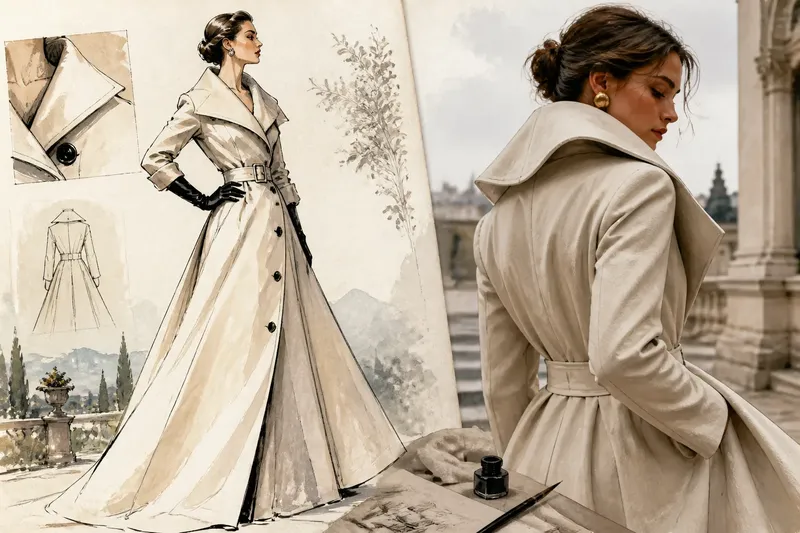
A fashion plate can make a sleeve look like an argument. An editorial photograph can show the same sleeve caught in a turn, creased by movement or held still for the lens. Fashion plate and editorial photograph are not simply older and newer versions of the same page: each makes clothing visible through a different kind of decision.
The distinction matters because illustration is often described as a substitute for photography, as though it were waiting for a camera to arrive. A plate does something more deliberate. It selects, edits and clarifies, while a photograph builds its account from a particular body, setting and moment. These differences can be read in the garment itself.
Fashion plates organise the silhouette
A plate can lengthen a figure, sharpen a shoulder or let a skirt occupy nearly the whole page. These choices guide the eye towards a garment’s outline before its fabric or construction. The body becomes a carefully arranged support for a shape that may be difficult to grasp in ordinary movement.
That arrangement is interpretive, not neutral. An illustrator can enlarge a train, simplify a fold or place the hands so that a waistline remains visible. The result tells a reader which proportions are meant to matter. A photograph may also direct attention, through pose and framing, but it records the garment on a particular person rather than drawing its outline afresh.
Illustration edits detail into legibility
Small details can disappear in a crowded image. A drawn button, collar or embroidered border can be made unusually clear, even when the rest of the garment is rendered with broad, economical marks. The plate can therefore behave like a visual explanation, giving a detail more space than it might receive in a camera’s view.
This clarity has a trade-off. A drawing can indicate the structure of a cuff without showing exactly how its material catches light or bends against a wrist. Photography can supply those surface clues, though a close crop or shadow may obscure another feature. Neither medium gives every kind of information at once; each makes some details easier to read.
The fashion plate places clothing in an imagined world
Illustration can detach a garment from the limits of a specific room or moment. A drawn figure might stand in a spare setting, against a lightly suggested landscape or among objects that signal a particular social scene. Background and pose can be adjusted until they support the clothing rather than compete with it.
That imagined setting is still a claim about how clothes belong in public. A formal gown shown in a grand interior proposes one sort of occasion; the same gown against an empty field suggests another. Editorial photography also builds context, but its locations and bodies retain the visible traces of a particular photographic scene, even when styling makes that scene look effortless.
Editorial photographs keep the body specific
A photograph makes the garment’s relationship with a particular body hard to ignore. The fabric may pull across a shoulder, gather at the hip or hang differently as the model shifts weight. These details can make fit and movement easier to imagine than a highly composed plate does.
Specificity is not the same as completeness. A camera records only what falls within the frame and the chosen moment. A carefully posed figure may conceal how a skirt moves when walking, while a tight crop can leave the cut of a jacket uncertain. The photograph is evidence of an appearance, not an all-purpose description of the garment.
Readers can compare the two images by asking different questions
Looking at both forms side by side is more useful than asking which is more accurate. One image may be better at making a silhouette intelligible; the other may reveal how cloth behaves on a living body. The following questions help distinguish their contributions.
What does a fashion plate clarify?
It can make proportions, decorative details and the intended outline unusually easy to see. Notice which features have been enlarged or simplified, since those edits often show what the illustrator considers central.
What can an editorial photograph show that a drawing may soften?
Look for the pressure of fabric against the body, the fall of a hem and the way a material responds to light. These are visible traces of a garment worn in a particular pose, though the frame may exclude other useful views.
Does illustration make a garment less truthful?
Not necessarily; it gives a different kind of account. A plate can be candid about its priorities through emphasis and omission, while a photograph can seem immediate even when its pose, crop and setting are carefully chosen.
Which image is more useful for understanding construction?
That depends on the question. A plate may separate a collar or trim from visual clutter, while a photograph may show how seams and fabric sit on the body; neither should be treated as a complete pattern or technical specification.
Each medium makes a different bargain with the reader
Imagine a reader comparing a plate and an editorial photograph of a coat with a broad collar. The plate emphasises the collar’s sweep and draws the button line clearly; the photograph shows the collar folding against the wearer’s neck as the head turns. Together, they offer a more layered view than either alone, without pretending to provide a full account of the coat’s construction.
This is why the plate should not be filed away as an imperfect photograph. Its simplifications can be purposeful, and its exaggerations can make design ideas easier to recognise. The editorial photograph, meanwhile, gives clothing a body and a moment, but its apparent directness does not remove the choices behind the frame.
When you encounter a fashion plate, ask what it has made larger, clearer or more graceful; when you encounter an editorial photograph, ask what the chosen body, pose and crop reveal or conceal. Fashion plate and editorial photograph each teach the eye to notice different things, and that difference is the point of reading them together.