What a Runway Set Adds Before the First Look Appears
A runway set frames the show before clothing takes focus. Learn how entrances, sightlines and materials shape the audience’s first reading.
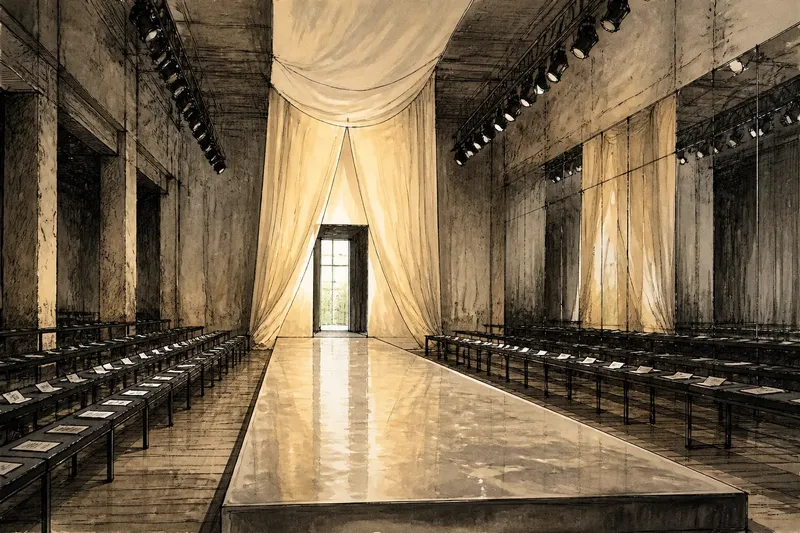
Before a model appears, the audience has already begun reading the room. At a show in a bare hall, a single doorway at the far end suggests a clear procession; add a mirrored wall or a narrow passage and that expectation changes. A runway set establishes a visual premise before the first look arrives, using space, entrances and sightlines to tell viewers how to watch.
What does a runway set communicate before the clothes appear?
A set gives the collection an initial context. It can make the show feel formal, intimate, theatrical, industrial or deliberately plain, without explaining any of those ideas in words. The audience takes in surfaces, scale, light and the placement of the runway, then carries that first impression into the clothing.
This is not the same as saying that a set dictates what each garment means. Rather, it supplies a frame. A collection of sharply tailored pieces shown in a cavernous, echoing room may seem more severe than the same clothes presented in a close, domestic arrangement. The set affects the first reading; the clothes can confirm, complicate or contradict it.
Materials are part of that frame. A polished floor catches light and movement, while a rough timber platform makes the same passage appear less ceremonious. Fabric suspended overhead can lower the apparent ceiling and draw attention to the route below. These details are legible before viewers can identify a hem, a fastener or the cut of a sleeve.
How does the entrance shape the audience’s first impression?
The entrance determines where the show begins to become visible. A model emerging from a dark opening arrives as a reveal; one entering from a side aisle appears already within the audience’s space. A concealed entrance can build anticipation, while a plainly visible one makes the mechanics of presentation part of the scene.
The entrance also sets the rhythm of attention. If it is close to the first row, the audience gets little time to register a look before it passes. A distant opening allows the figure to become visible gradually, with silhouette and movement arriving before fine detail. Designers and show teams can use that difference to decide whether the first impression should be a sudden image or a measured approach.
There is a practical side to this visual choice. The entrance has to connect with the route models will take and the place they will leave the audience’s view. If those transitions are confusing, people may turn away from the runway to follow movement elsewhere. The room then asks viewers to solve its traffic pattern instead of watching the clothes.
Why do sightlines change how a runway looks?
Sightlines determine what viewers can see from their seats and at what angle. A straight runway gives the audience at its end a direct view of approaching silhouettes, while spectators along the sides see garments in profile as models pass. A circular or intersecting route distributes those views differently, but can also make the action harder to follow from some seats.
Height matters as well. A raised platform can make the figure visible across a crowded room, yet it may hide shoes or the lower edge of a garment from people seated close to the runway. A runway at floor level brings models nearer to the audience but can leave heads and phones obstructing views behind the front rows. There is no universally ideal arrangement; the intended viewing distance and the venue’s constraints both matter.
Imagine a small show in a long gallery, with a narrow central platform and a bright window behind the entrance. The organiser could angle the route slightly away from the window and leave clear space at the turning point. The expected visible result is a less silhouetted entrance and fewer blocked views of the exit, while the gallery still feels elongated. This is an invented situation, not a formula for every room.
What do light and materials add to the runway setting?
Light tells the audience where to look before the first model appears. A concentrated pool on the runway separates it from the surrounding room; even illumination makes the venue feel more continuous. A dim entrance can delay the reading of clothing, whereas bright overhead light makes the room’s surfaces and architecture more prominent.
The choice should account for the clothes as well as the set. A reflective floor may duplicate movement and compete with details on a garment. A dark backdrop can make light fabrics stand out while swallowing dark ones into the scene. These are not merely technical effects: they alter which parts of a look are easiest to notice and what visual mood arrives first.
Sound and room acoustics can reinforce the setting, but they should not be mistaken for its whole premise. A hard, empty room may make footsteps and music feel exposed; curtains, seating and temporary walls soften that impression. If the space is intended to feel restrained, a busy soundscape or a complicated lighting change can introduce a different message, whether planned or not.
How should a set relate to the collection rather than compete with it?
A useful set has a clear job. It might establish a scale, create a particular route, or give the audience a distinct point of view. When every surface, light cue and architectural feature demands attention, viewers have to divide their focus before the clothes appear. A simpler arrangement can make a strong premise easier to read.
One way to judge the balance is to consider what the set makes visible at each point: the entrance, the full figure, the side view, the turn and the departure. If a scenic feature obscures one of those moments, it should have a reason to do so. The question is not whether the set looks impressive in an empty room, but whether its presence helps the audience follow the show.
Documentation matters too. A room that feels coherent in person may look fragmented in photographs if a large structure blocks the background or if the runway disappears from a common camera position. The set’s visual premise will be encountered by people who were not in the venue, so the composition needs to remain readable from the seats and from the angles used to record the event.
How can organisers judge a runway set before show day?
A walk-through offers a useful check without requiring a finished production. Organisers can stand at the entrance, along the sides, at the runway’s end and in the back rows, then ask what the room communicates from each position. The exercise often reveals that the intended view belongs to only one seat.
- Check the entrance: Can the audience see where models appear, and does that opening make the intended first impression?
- Check the route: Is the path easy to follow, including its turns and exit?
- Check the front rows: Can seated viewers see the full figure without an awkward upward angle?
- Check the rear seats: Do people have a clear view over the audience and any scenic structures?
- Check the materials: Do floors, walls and backdrops reflect light or visually merge with the clothing?
- Check the camera positions: Can a photographer record the entrance, passage and turn without the set cutting across the image?
For venue-specific restrictions or construction questions, the venue’s instructions and the relevant qualified professionals should guide decisions. The set is an image, but it occupies a real room with real people moving through it.
Does a runway set still matter in livestreams and short clips?
Yes, because screens crop the room rather than erase it. A livestream may show only the runway and one strip of background, while a short clip may begin after the entrance and end before the turn. The set’s premise needs to survive those partial views: a distinctive doorway, a consistent backdrop or a clear route can help identify the show even when the viewer sees only a fragment.
At the same time, a set designed solely for a wide in-person view can lose its shape on a phone. Tall structures may disappear beyond the frame, and a long approach can become a brief walk with little sense of distance. Thinking about the likely camera angles alongside the room’s seated views helps keep the visual idea legible across formats.
A runway set does its first work in the pause before the clothes arrive. Its entrance points the eye, its sightlines distribute attention, and its materials establish the room’s tone. For anyone considering what a runway set adds, the useful question is simple: what will the audience notice first, and will that make them better prepared to see the collection?